Wilderness First Aid Certification Courses
Learn foundational first aid principles and skills to respond to illnesses, injuries, and environmental hazards in areas where emergency medical services (EMS) are not quickly available. This content is intended for both wilderness and remote environments, including natural disaster urban settings, such as earthquakes and hurricanes.
Contact: oa@recreation.ucla.edu
UPCOMING ENROLLMENT DATES
- October 10-11, 2026, 9:00 AM – 6:00 PM. Fall Registration Open Now
- February 6-7, 2027, 9:00 AM – 6:00 PM. Registration opens December 7 at 12:00 PM, noon
- February 27-28, 2027, 9:00 AM – 6:00 PM. Registration opens December 7 at 12:00 PM, noon
- April 3-4, 2027, 9:00 AM – 6:00 PM. Registration opens March 8 at 12:00 PM, noon
- May 1-2, 2027, 9:00 AM – 6:00 PM. Registration opens March 8 at 12:00 PM, noon
Sign up for the waitlist/mailing list for updates.
Eligibility & Registration
Anyone age 17+ years is eligible to enroll in the Wilderness First Aid course, including individuals who are not affiliated with UCLA and/or do not have UCLA Recreation membership. UCLA Recreation members, however, receive discounted fees.
Current Adult CPR/AED Certification Required
Participants will be required to show proof of certification prior to beginning the course. Certification from any organization is accepted. If you do not already have this certification, you are invited to register for the WFA CPR/AED prerequisite add-on course. This course is conveniently scheduled for 7:30 AM, immediately prior to to day 1 of each WFA offering. The CPR course consists of a few hours of asynchronous online learning, and 90 minutes of in-person instruction.
Adult (18+) Registration
WFA Certification Course Pricing
- WFA course fees
- $260 for current UCLA students and Rec members
- $325 for non-members
- CPR/AED Prerequisite Course: $50 per person
Minor/Youth Registration: Email Member Services (info@recreation.ucla.edu) for instructions on how to register minors.
Essentials and Logistics
Certification (including course curriculum and standard) is provided by American Red Cross.
Pre-Course Work
None
Requirements for Certification
- Attend all class sessions in their entirety. No make up sessions are available.
- Participate in all skill sessions and activities
- Demonstrate competency in all observable skills
- Complete the scenarios
- If certification required by employer or organization, pass the optional final written exam with a minimum grade of 80 percent
Duration
16 hours. Breaks taken periodically. For courses taking place over a full day (e.g. 8-9 hours) a 1-hour lunch break will be scheduled midday. In those cases, we recommend participants bring lunch with them to the course, as there are no nearby options for easy/quick purchase of food.
Location - Sunset Canyon Rec Center
This course will take place at UCLA’s Sunset Canyon Recreation Center (SCRC), inside the Mesa Room. The address for Sunset Canyon Recreation Center is 111 Easton Drive, CA 90095. However, each individual course may be scheduled at differing locations. The planned location will be listed on the registration offering and reiterated to participants in reminder pre-course emails.
Parking
For courses taking place at SCRC, the closest parking lots are Parking Lot 11 and Parking Lot RC. Parking day passes can be purchased from the automated kiosks located in the lot. Fees are posted here for your reference. UCLA students, staff, and faculty can purchase parking passes from the Bruin ePermit system. Staff/faculty who already possess a UCLA parking permit and wish to know if their parking pass allows them to park in either of these nearby lots, should consult the Parking Privileges document.
Content & Nature of the Course
Lecture, Discussion, and Hands-On Practice
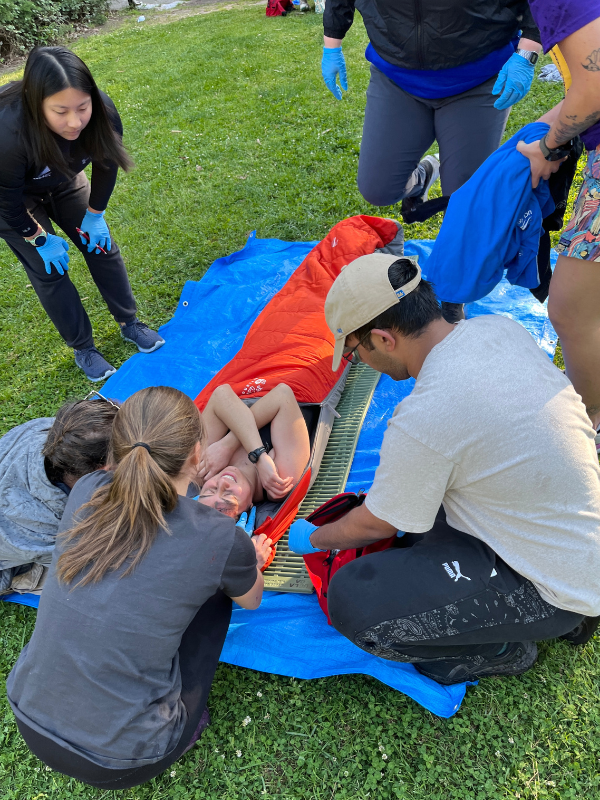
Participants of the Wilderness First Aid certification course should expect a combination of lecture, discussion, and hands-on practice. The hands-on practice elements will include specific skill sessions (e.g. splinting a bone or joint injury, building a hypo wrap) and mock scenarios where students practice the entire patient assessment procedure, deliver relevant treatments, and make an evacuation plan. The scenarios typically involve roughly one-third of the participants playing the role of “patient” and the other two-thirds of the class working in teams of 2 to assess and treat the patient. Moulage may be used to simulate wounds (e.g. bruises, lacerations, abrasions, punctures, etc.).
Physical Touch
Physical touch between class participants is a requirement to properly learn and practice the curriculum. Part of the patient assessment procedure includes a full-body physical exam, which involves the rescuer systematically palpating the patient’s entire body, looking for deformities, obvious injuries, tenderness, and swelling. At the start of the course, the instructor will review how to palpate a patient in a professional manner, emphasizing that the groin and buttocks are always excluded from assessment during this course. The instructor will monitor participant performance and correct for appropriateness. Participants may make requests to the instructor to practice scenarios with similar gender, age, or other characteristics as themselves. These requests may be submitted via email to oa@recreation.ucla.edu prior to the start of the course, or verbally to the instructor once the course has begun. The instructor will try to accommodate these requests, but no guarantees can be promised. Participant characteristics, such as gender and age, will not be known in advance. Additionally, preferred participant pairings may not be logistically feasible if, for example, there are insufficient quantities of participants in the course that match the requesting participant’s preferences.
Indoor/Outdoor
Portions of the course will take place both inside and outside. Participants should come prepared for both environments, including inclement weather. Rain, wind, hot, or cold – we train outdoors regardless of weather conditions, as it helps simulate realistic wilderness settings.
Subjects Covered
- Definition of wilderness and remote setting
- Primary patient assessment procedure
- Secondary patient assessment procedure
- Calling for help and evacuation considerations
- Shock and heart attack
- Chest injuries
- Head, neck, and spinal injuries
- Wounds and wound infection
- Bone and joint injuries
- Burns
- Abdominal illness
- Hypothermia
- Heat-related illness
- Lightning
- Altitude illness
- Submersion incidents
- Allergies and anaphylaxis
What to Bring
- Notebook and pencil/pen
- Personal bottle of hand sanitizer
- Watch with a second hand or digital second
- Sunglasses and/or protective eyewear
- Water bottle, personal snacks, Lunch (for courses that take place all-day; there are no nearby option where one may easily/quickly purchase food)
- Headlamp (if course take place outside of daylight hours)
- Close-toed, sturdy shoes, such as light hiking boots, sneakers, or athletic shoes
- Clothing layers that allow you to be comfortable in a variety of weather conditions, including a hat
- Optional: personal camping and first aid supplies that you typically carry, such as a sleeping bag, ground pad, hiking pole, extra layers, and your own first aid supplies. You may opt to use your own equipment when practicing responding to scenarios.
Reserve a private WFA course for your club, group, or department
Do you have a group of 6-10 people that would all like to take this course all together? Consider scheduling your own, private group course. The group organizer will be responsible for scheduling and paying for the course. They may choose to fill the course with any 6-10 people of their choosing, provided all participants are at least 17 years old.
Contact oa@recreation.ucla.edu for more details, including fees, logistics, and availability.
Policies
- Cancellations: 90% refunds will be granted to participants who submit a Cancellation Request Form by noon (PST), at least 7 days prior to the start of the course. Transfers to future/alternate courses are not available.
- Refunds requested due to claimed lack of knowledge or understanding of this agreement will not be honored. Failure to meet certification requirements does not entitle one to a refund.
- There are no makeup sessions for missed class sessions.
- UCLA Policy 810 : Smoke and Tobacco-Free Environment
- UCLA Policy 135 : Animals on University Property
Photo Gallery
Photos of the WFA Course